
How Employee Engagement Impacts Company Success in India


Most HR conversations in India eventually circle back to the same question: does engagement actually move the needle on business results, or is it a soft metric that looks good in a board deck? The data says it moves the needle — consistently and measurably.
How does employee engagement impact company success in India? Employee engagement directly affects productivity, revenue growth, profitability, attrition, and customer satisfaction — and the relationship is well documented globally, including in the sectors that dominate Indian employment such as IT services, BFSI, and retail. Companies with highly engaged workforces consistently outperform low-engagement peers on profitability and productivity, while facing significantly lower turnover — a particularly high-stakes advantage in India's competitive, high-attrition talent market. This article breaks down what engagement actually means, what the research shows, and the practical levers Indian companies can pull to improve it.
Key Takeaways
• Engagement is not the same as satisfaction — a satisfied employee may still be disengaged and unproductive, while an engaged employee is actively invested in outcomes.
• Global research consistently links higher engagement to meaningfully higher profitability and productivity, and lower engagement to significant lost economic output worldwide.
• In India's high-attrition talent market, engagement is directly tied to retention and hiring costs, which compound quickly in competitive sectors like IT/ITES and BFSI.
• Engagement also flows through to customer satisfaction and brand reputation, particularly in customer-facing and service-led industries.
• Four practical levers move the needle fastest: recognition programs, clear career growth paths, manager training, and structured feedback loops.
• Engagement should be measured continuously — through pulse surveys, eNPS, and periodic culture assessments — not inferred from annual survey results alone.
Employee Engagement vs. Employee Satisfaction
These two terms get used interchangeably, but they measure different things — and the difference matters for what you do with the data.
Employee Satisfaction
Satisfaction measures how content an employee is with their job conditions — pay, benefits, work environment, hours. A satisfied employee isn't necessarily motivated to go above and beyond; they may simply find the arrangement acceptable enough not to leave.
Employee Engagement
Engagement measures psychological investment — how connected an employee feels to their work, their team, and the organization's goals. Engaged employees are more likely to take initiative, advocate for the company, and sustain performance even when conditions aren't perfect. An employee can be satisfied and still disengaged — comfortable, but coasting.
This distinction is why engagement, not satisfaction alone, tends to be the stronger predictor of business outcomes like productivity and retention.
The Link Between Engagement, Productivity, and Profitability
Gallup's long-running global workplace research — based on meta-analysis across hundreds of thousands of business units worldwide — has consistently found a strong relationship between employee engagement and business performance. Business units in the top quartile for engagement have been shown to outperform those in the bottom quartile by a meaningful margin on both productivity and profitability, alongside better safety records and lower absenteeism.
At a macro level, global engagement has hovered stubbornly low for over a decade — generally in the low-to-mid twenties as a percentage of the workforce — and Gallup's most recent estimates put the annual cost of this disengagement at around $10 trillion in lost productivity worldwide, roughly 9% of global GDP. For India's largest employment sectors — IT services, ITES, BFSI, and manufacturing — this isn't an abstract global statistic; these are industries operating on thin margins and high headcount, where even modest engagement gaps compound into significant productivity losses at scale.
One consistent finding worth highlighting for Indian HR leaders: research points to management as the single largest lever, accounting for the majority of the variance in team-level engagement. This means engagement improvement efforts that skip manager capability and go straight to perks or events tend to underperform.
Impact on Attrition and Hiring Costs in the Indian Job Market
India's white-collar job market has become significantly more fluid over the past several years, with high voluntary attrition a persistent challenge in IT services, ITES, e-commerce, and BFSI. Engagement is one of the strongest levers against this, since research on high-turnover organizations has found that lifting engagement can reduce turnover by roughly a fifth in high-turnover environments, and by considerably more in organizations that already have lower baseline turnover.
The financial stakes are significant. Replacing a mid-level employee in India typically costs a company anywhere from half to twice their annual salary once recruitment, onboarding, and productivity ramp-up are factored in — and that's before accounting for the knowledge loss and team disruption that comes with each departure. In competitive Indian hiring markets, where the same pool of experienced talent is contested across dozens of employers, keeping current engagement high is often more cost-effective than trying to out-recruit competitors on compensation alone.
Impact on Customer Satisfaction and Brand Reputation
Engagement doesn't stop at the internal HR dashboard — it flows outward, particularly in customer-facing and service-led industries that make up a large share of the Indian economy, from BPOs and IT services to retail and hospitality. Engaged employees tend to deliver more consistent service quality and demonstrate stronger discretionary effort, both of which show up directly in customer satisfaction scores.
There's also a brand reputation dimension that's grown more visible in India specifically. Platforms like Glassdoor and AmbitionBox mean disengaged employees' experiences — and complaints — are now searchable by future candidates and, in some cases, by prospective clients evaluating a vendor. A visibly engaged, well-treated workforce has become a quiet but real competitive advantage in both recruitment and B2B trust-building.
Practical Levers Indian Companies Can Pull to Improve Engagement
Improving engagement doesn't require a complete culture overhaul. Four levers consistently show up as high-impact starting points:
1. Recognition Programs
Structured, consistent recognition — not just an annual awards ceremony — helps employees see that their specific contributions are noticed. This matters especially in larger Indian organizations where individual contributions can otherwise go unseen across layers of hierarchy.
2. Clear Career Growth Paths
Ambiguity about promotion criteria and growth timelines is a persistent engagement (and attrition) driver in Indian companies, particularly among younger employees. Transparent, well-communicated career pathways — even when promotions aren't immediate — measurably improve engagement by giving employees a sense of forward motion.
3. Manager Training
Given how much of the variance in team engagement traces back to management, investing in manager capability — feedback delivery, coaching skills, workload management — tends to produce outsized returns compared to broad, generic engagement initiatives that bypass the manager layer entirely.
4. Structured Feedback Loops
Engagement erodes quickly when employees feel unheard. Regular, structured feedback loops — pulse check-ins, skip-level conversations, and visible follow-through on past feedback — signal that leadership is actually listening, which sustains engagement between larger annual surveys.
How to Measure Engagement
Engagement should be tracked continuously rather than inferred once a year. Three commonly used measurement approaches, often used together:
•Pulse surveys — short, frequent surveys (monthly or quarterly) that track sentiment trends in near real-time, useful for catching dips before they show up in attrition data.
• Employee Net Promoter Score (eNPS) — a single, simple metric asking employees how likely they are to recommend the company as a place to work, tracked over time as a quick directional indicator.
• Culture assessments — deeper, periodic assessments covering leadership, communication, growth, inclusion, and well-being, typically benchmarked against industry peers rather than measured in isolation.
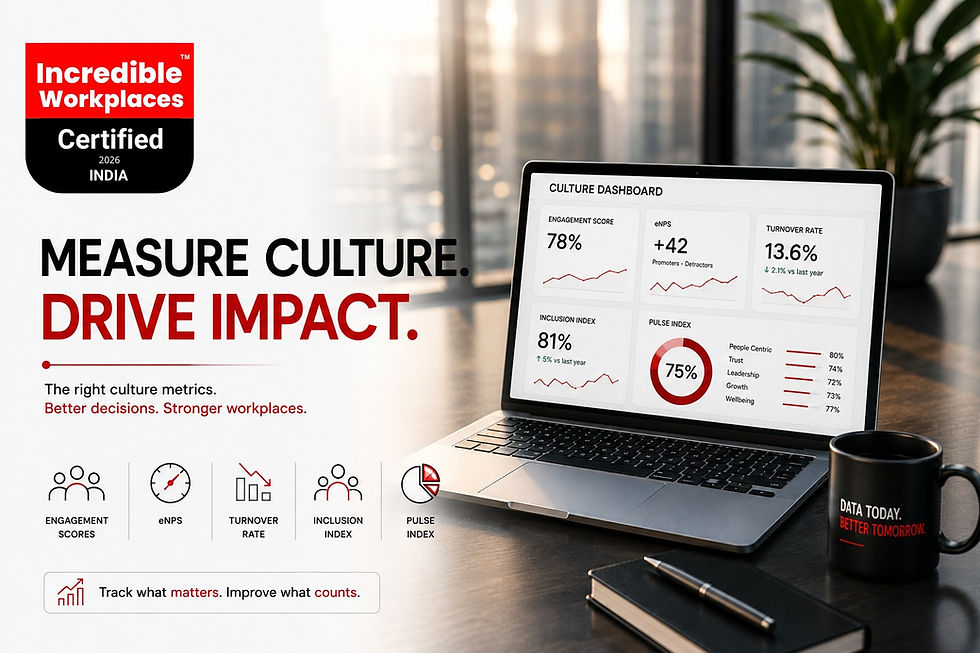
Pulse surveys and eNPS are good for tracking short-term trends, while a structured culture assessment provides the deeper, benchmarked diagnostic needed to understand why engagement is moving the way it is. This is the kind of assessment and consulting support Incredible Workplaces provides for Indian companies — combining employee survey data with benchmarking against industry peers to help HR teams see not just their engagement score, but the specific drivers behind it, along with guidance on which levers to prioritize.
Frequently Asked Questions
Q1. How does employee engagement impact company success in India?
Employee engagement directly affects productivity, revenue growth, and profitability, and it's one of the strongest levers against the high attrition that characterizes India's competitive talent market — particularly in IT services, ITES, and BFSI. Higher engagement also improves customer satisfaction in service-led industries and strengthens employer brand reputation, which increasingly matters given how visible employee experiences have become on platforms like Glassdoor and AmbitionBox.
Q2. What's the difference between employee engagement and employee satisfaction?
Satisfaction measures how content an employee is with job conditions like pay and work environment, while engagement measures their psychological investment in their work and the organization's goals. An employee can be satisfied but still disengaged — comfortable enough to stay, but not motivated to go above and beyond — which is why engagement is generally the stronger predictor of business performance.
Q3. How often should companies measure engagement?
Most organizations benefit from a layered approach: frequent pulse surveys (monthly or quarterly) to catch short-term sentiment shifts, a continuously tracked eNPS score, and a deeper, benchmarked culture assessment on an annual cycle to understand the underlying drivers behind engagement trends.
Q4. Which factor has the biggest impact on employee engagement?
Management consistently emerges as the single largest driver of team-level engagement in workplace research, accounting for the majority of the variance between highly engaged and disengaged teams. This is why manager training tends to produce a bigger engagement return than broad perks or one-off initiatives that don't address day-to-day management quality.
Find Out Where Your Engagement Stands
If you're relying on assumptions rather than data to gauge how engaged your workforce actually is, a structured assessment is the fastest way to get clarity.
Get an engagement and culture assessment from Incredible Workplaces to see exactly where your organization stands, benchmarked against Indian industry peers, along with guidance on the levers that will move your engagement the most.


Comments